

Every working day, hundreds of thousands of Australians trust their lives to bus, tram, light rail, ferry, and heavy rail drivers. The expectation is absolute: a 0.00 per cent BAC behind the wheel of a public passenger service vehicle. Across the country, transport regulators have moved from policing that expectation with random roadside testing to engineering it into the vehicle itself. Commercial alcohol interlocks, fitted to the start circuit, are increasingly the default control rather than the exception.
For fleet operators, transit authorities and government contractors, the question has shifted from “do we test our drivers?” to “what does our preventative testing program look like, and is it audit-ready?”. This guide walks through the legislative position state by state, explains how a commercial interlock differs from a court-ordered personal one, and lays out what fleet managers should be checking for now to be ready for the volume of public-transport scrutiny coming with major events through to the 2032 Olympics.
Government mandates: state by state
New South Wales: Transport for NSW and the Passenger Transport regulation
NSW operates one of the most prescriptive frameworks in Australia. Transport for NSW requires every accredited bus operator to maintain a Drug and Alcohol Management Program, commonly shortened to DAMP. The DAMP must cover screening at engagement, randomised testing during service, post-incident testing, and reasonable-cause testing where a supervisor identifies a fitness-for-duty concern. NSW’s drug and alcohol testing rules for bus operators sit within the Passenger Transport (General) Regulation, and operators are audited on whether their DAMP is documented, current, and applied evenly across the workforce.
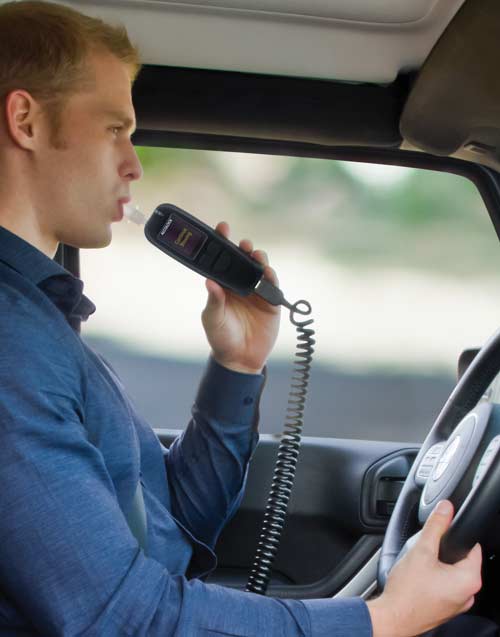
Where a commercial interlock fits inside this framework is at the pre-shift “fitness for duty” gate. A driver who blows clean on the in-cab device starts the vehicle. A driver who registers any alcohol cannot start it, and the event is logged. The interlock takes the most contentious moment in the supervisor / driver relationship and replaces it with an objective, repeatable, time-stamped reading.
Queensland: TMR Driver Authorisation
In Queensland, the Department of Transport and Main Roads regulates Driver Authorisation for passenger transport. A driver who is currently subject to an alcohol interlock condition on their licence is ineligible to hold a Driver Authorisation, which means they cannot lawfully drive any public passenger service vehicle in the state. Queensland’s Driver Authorisation eligibility and suitability page lays this out clearly.
For fleet operators, the implication is that the commercial interlock is not just a defensive control. It is the mechanism that lets the operator demonstrate to TMR, and to insurers, that every driver entering a vehicle is currently fit-for-duty under the same standard the regulator already applies at the licence level. A fleet that runs on commercial interlocks is producing the audit trail Driver Authorisation already implies.
Western Australia: Transport WA and the Alcohol Interlock Scheme
In Western Australia, the Department of Transport runs the Alcohol Interlock Scheme. The scheme uses certified interlock devices for the personal-program path, and Transport WA’s standards drive the certification testing every approved device must pass. Commercial operators in WA reference the same certified-device standard when specifying interlocks for their pre-shift checks, because it is the closest the state offers to a benchmark for “is this hardware fit for safety-critical use.”
Across all three states, the consistent thread is that interlock hardware approved for personal-program use is the only hardware operators can defensibly point at for commercial pre-shift testing. Devices that have not been through state certification carry no audit weight if a workplace incident leads to a regulator review.
Commercial interlocks versus personal interlocks
The two share the underlying physics: a deep-breath sample, a fuel-cell sensor, a lockout if alcohol is detected, and a retry window. They diverge in everything that surrounds the sample.
A personal interlock is fitted because a court has imposed it. It belongs to the program participant, it reports to the relevant state authority, and it is calibrated and serviced on a schedule that authority sets. It is, in essence, a piece of supervised compliance hardware.
A commercial interlock is fitted because the operator has decided their fleet should not start without a clean sample. It belongs to the operator. It reports into the operator’s own fleet management system, often alongside GPS, dash camera, fatigue monitoring, and maintenance telemetry. It can be configured for the operator’s risk profile (whether to log a near-miss reading, whether to require a randomised re-test mid-shift, whether to require a supervisor PIN for an override). And it can be removed when the operator decides it is no longer needed, without any regulator approval.
The other practical difference is throughput. A commercial unit has to clear a clean sample fast enough that depot start-times are not derailed. The fuel-cell sensors used in current commercial-grade interlocks return a result inside a few seconds. A modern interlock kit (handset, ECU, harness, camera) is engineered to fit between the depot wash and the route brief, not to interrupt them.
SafeWork Australia and rail safety law
Bus, tram and light-rail operations sit under state passenger-transport regulators. Heavy rail is national, and the Office of the National Rail Safety Regulator (ONRSR) sets the standard. ONRSR’s Drug and Alcohol Management Program guidance requires every rail transport operator to have a written DAMP that covers pre-employment, randomised, for-cause, and post-incident testing.
Rail safety workers, the ONRSR-defined category that covers drivers, signallers, network controllers and a wider list of safety-critical roles, face a 0.00 per cent BAC limit at all times when on duty. There is no permissive threshold; the only legal reading is zero. ONRSR audits rail operators against the DAMP, and operators that have integrated commercial interlocks at depot or stabling-point level produce a stronger audit position than those still relying on roving random tests.
The broader principle sits in Australian work health and safety law. Where an operator can identify a foreseeable risk, the duty is to put in place “reasonably practicable” controls. For mass transit, where the consequence of an impaired driver is measured in lives, the bar for what is “reasonably practicable” has moved. Random testing once a quarter is no longer it. Pre-shift interlock testing every shift, every driver, every vehicle is what the regulators are now treating as the practicable benchmark.
What good looks like for a transit fleet
A fleet that has its commercial interlock program in working order will have five things in place at any audit point.
First, every safety-critical vehicle has a fitted interlock from a hardware family that holds current state certification. Second, the certifications are current; calibration cycles are scheduled, completed, and recorded. Third, the data the interlocks generate, including failed starts, lockouts, and supervisor overrides, flows into a single fleet-management view rather than living on individual handsets. Fourth, there is a written procedure for how a positive reading is handled, who is told, and what the driver’s path back to duty looks like. Fifth, there is evidence the procedure has been followed when a positive reading has come up.
Operators who can produce all five at audit consistently come out the other side of an ONRSR or state regulator review with no findings. Operators who can produce hardware but no records, or records but no current certifications, do not.
The 2032 horizon
Brisbane in 2032 is the first Olympic Games at which commercial interlock telemetry will be a normal part of mass-transit operations rather than a vanguard practice. The infrastructure decisions made between now and then will determine whether transit authorities arrive at the Games with audit-ready, real-time visibility across every public-transport vehicle, or with a patchwork of legacy random-testing programs and gaps in the data trail.
For fleet managers, contractors and transit authorities reading this now, the practical move is to audit the current state. Confirm every safety-critical vehicle has a current-generation interlock fitted. Confirm calibration cycles are on schedule. Confirm the data is reaching a single management view. The work scales much more cheaply done in the next few procurement cycles than retrofitted under deadline pressure.
For a confidential review of a fleet’s interlock posture, including hardware certification, calibration cadence, and DAMP audit-readiness, the our team at Affordable Interlock Systems can be contacted via the commercial interlock enquiries page. Affordable Interlock Systems is the exclusive Australian service agent for ALCOLOCK, holds current state certifications across NSW, QLD, ACT and WA, and has installer partnerships across all three states for fleet-wide rollouts.